History
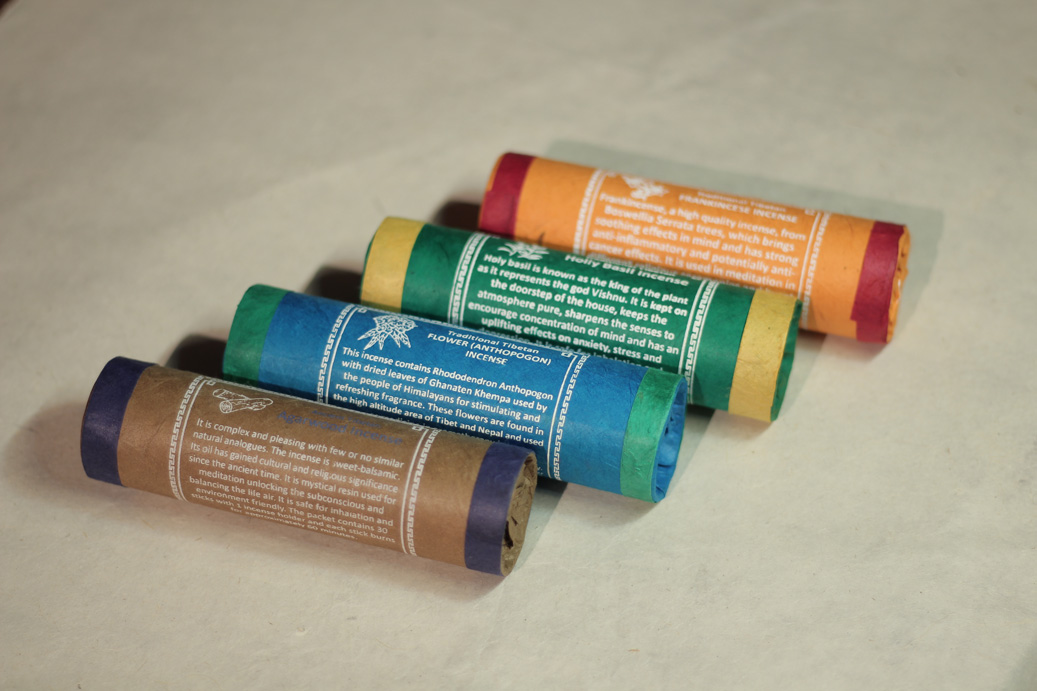
Tibetan incense is made in Tibet, Nepal & Bhutan. Incense is an important representation of the Asian culture. These incenses have a characteristic “earthy” or herbal scent to them. As with most Asian incense, Tibetan incense is not rolled around a bamboo stick, but is extruded into lengths or coils.
What is Tibetan Incense?
Made from all natural ingredients, with no harmful glues or carcinogens, there are hundreds of different types of incense that have been used by the monks and people for hundreds of years. Compared to incense from other places in the world, Tibetan incense is unique. It is made by hand, using only pure herbs, spices, flowers and it does not contain a central stick of bamboo to hold it together.
In Tibetan medicine, incense is regarded as a way of treatment for various ailments. This information can be found in Tibetan medical books which originated from the four Tantras (Root Tantra, Tantra of Enlightenment, Tantra of Instructions, Concluding Tantra) which is also known as Gyudbzhi in Tibetan. It is the central work upon which contemporary Tibetan medicine is based. Tibetan medical theory states that everything in the universe is made up of the 5 proto-elements: sa (earth), chu (water), me (fire), rLung (wind or air), and Nam-mkha (space). But only four play a role in the classification of our illnesses, except Nam-mkha. Each element contains eight active forces and 17 qualities. Some of these elements are contained in our three bodily energies and their imbalance affects the equilibrium of the three ‘fluids’, rLung, mkhrispa/tripa and badkan which can be considered as vata(wind), pitta(bile), kapha(phelgm).
Authentic Tibetan incense originates either from traditional monastery or medical college/hospital formulation, so Tibetan incense follows a particular lineage which can be traced back to the originator. Over the years, Tibetan incense making have been polluted and over commercialized which leads to incense formulation by non-authentic makers. This has affected and degenerated the Tibetan incense formulation and making methods to a certain degree, which forms an important part of the unique Tibetan Culture. But there are still some in parts of Nepal and Bhutan that produce Tibetan incense in an authentic manner, by using authentic Himalayan herbs and ingredients. Widely used for relaxation, meditation and the cleansing of the home environment, it has an aroma that often helps to calm and soothe restless minds. Incense is also widely used in Buddhist temples and monasteries, & people will burn incense in the temples while worshiping Buddha.
How traditional Tibetan incense is made ?
Tibetan incense is made up of many different types of herbs, spices and flowers, and can contain as many as 30 different ingredients. The main ingredient of Tibetan incense is wood. The wood is cut into small pieces and then ground into a fine powder. The other required ingredients are then added and the mixture is put into a container and left to dry. The main ingredients found in most incense are: sandalwood, pine, cedar, frankincense, bdellium, juniper, cloves, nutmeg, valerian, anthopogon, cardamom & more. All these ingredients are beneficial to one’s health & the process of adding up all these ingredients in a single material is considered very auspicious & bring good fortune in one’s life.
Rope incense
Tibetans also use a rope incense. This is made using thin sheets of rice paper, cut into strips. A small amount of the dry, powdered ingredients are placed on the paper, and it is spread evenly along the length of the paper. It is then gently twirled between the fingers, twisting the paper, making sure not to break or rip it. Once it is twisted along its length, it is doubled back on itself and the two halves are twisted together in the same fashion. This forms the classic “rope” look of the incense. The sticks are traditionally burned in incense holders, standing upright, while the rope incense is normally burned either lying flat on a bed of ash, or in a miniature cast iron cauldron in bundles.
The History of Tibetan Incense and Buddhism Incense in Tibet is believed to have come from India over 1300 years ago and has been made in a time-honored method ever since. However, there are some ancient Tibetan texts that have been dated back over 2,000 years which include ingredients
and composition of incense. The sticks were made to very precise formulas and methods that were strictly controlled by the monks. Buddhist tradition says that, the Buddha made the first sticks himself and passed the secrets on to his disciples, as the “masters of incense”, placing at their disposal a powerful tool for healing and meditation. Ancient Bon texts also speak of cleansing the air with smoke, which alludes to the burning of incense.